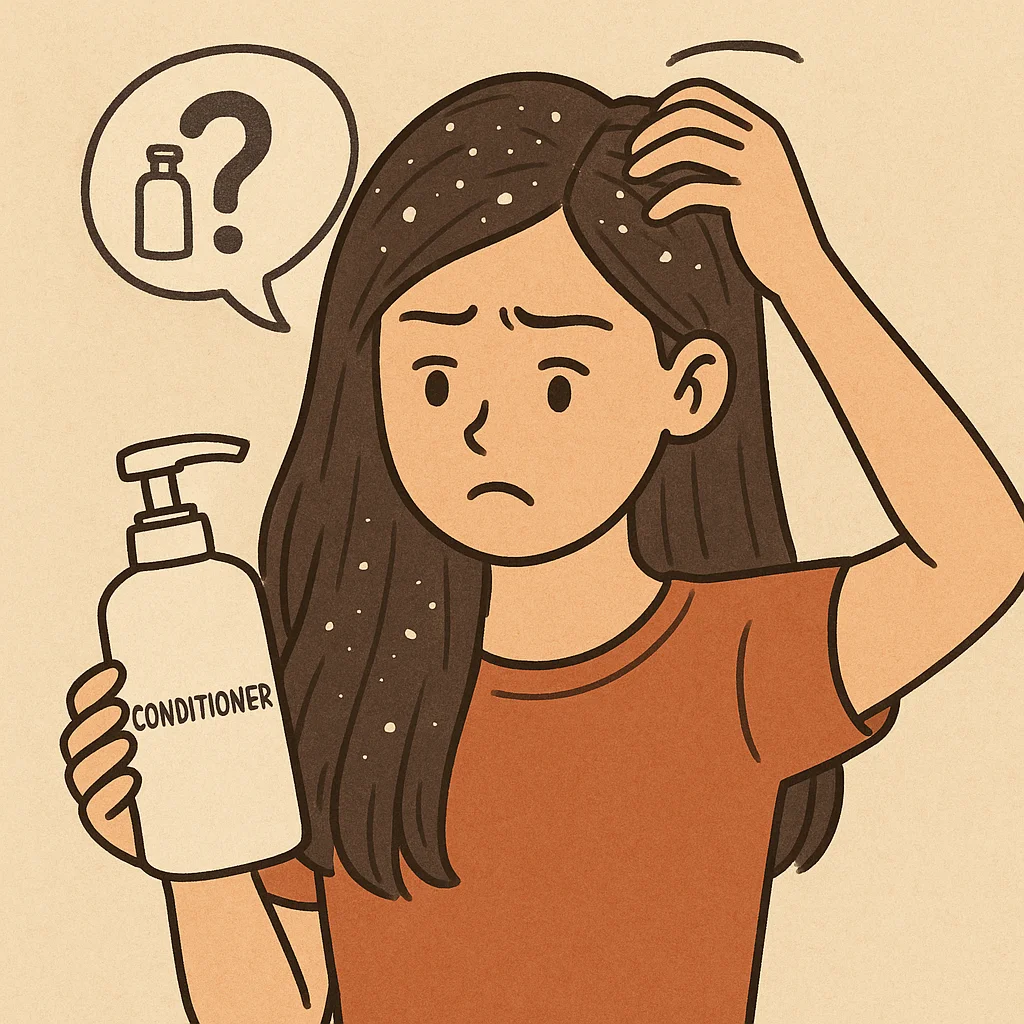
Can You Use Conditioner If You Have Dandruff? Here’s the Right Way To Do It
Whenever I talk about scalp care — whether it’s with clients, friends, or even fellow formulators — there’s one question that never fails to come up:
“Should I use conditioner if I have dandruff?”
Yes — you can and should use conditioner if you have dandruff; the key is choosing a lightweight, scalp-safe formula that restores moisture, repairs the scalp barrier, and complements your anti-dandruff shampoo to keep your scalp balanced, hydrated, and flake-free.
It’s such a simple question, yet the confusion around it runs deep. Over the years, I’ve realized that most people genuinely believe conditioner is something to avoid when flakes appear — as if hydration itself could somehow feed dandruff. I’ve had clients whisper, almost guiltily, that they stopped conditioning months ago because they thought it was “making their scalp worse.”
I understand why. Most anti-dandruff advice online focuses almost entirely on shampoo — scrub harder, cleanse deeper, remove oil, remove buildup. It’s no wonder people assume moisture is the enemy. But after years of working with scalp formulations and observing real results, I can tell you confidently:
Conditioner isn’t the problem — imbalance is.
What Dandruff Really Is (And Why It’s So Common)
When I first started learning about scalp health, I thought dandruff was just “dry skin on the head.” But after years of working with scalp-care formulas and seeing countless customers struggle with flakes, I’ve realized how misunderstood this condition really is. Dandruff isn’t just dryness — it’s a biological imbalance happening on one of the most delicate ecosystems of the human body: your scalp.
If your scalp feels itchy, tight, or starts shedding little white or yellowish flakes that land on your clothes, you’re far from alone. Studies show that nearly 50% of adults worldwide experience dandruff at some point, regardless of how often they wash their hair or what products they use. In other words, dandruff isn’t a hygiene problem — it’s a microbiome problem.
Let me explain what that means. Your scalp, like your gut or your skin, has a living community of microorganisms. One of the most dominant residents is a yeast called Malassezia. Normally, it lives peacefully on everyone’s scalp, feeding on natural oils (sebum) that your skin produces. But when the balance shifts — maybe because of stress, hormonal changes, diet, or even a new hair product — Malassezia can multiply too quickly. As it breaks down sebum, it releases free fatty acids that irritate the skin’s surface. The result? Inflammation, flaking, and itching — the perfect recipe for dandruff.
In many cases, the scalp also loses its natural barrier protection. Think of that barrier as a thin “shield” made of lipids and proteins that keeps moisture in and irritants out. When we overwash our hair, use strong surfactants, or expose our scalp to extreme weather changes, that shield weakens. Once it’s compromised, your scalp can become simultaneously oily and dehydrated — greasy roots but tight, dry skin underneath. That’s one reason dandruff can feel so paradoxical: you’re producing oil, yet your scalp feels uncomfortably dry.
Now, let’s clear up one of the biggest confusions I see among my own clients: dandruff versus dry scalp. They look similar, but they behave very differently.
- A dry scalp usually means your skin isn’t producing or retaining enough oil. The flakes are small, powdery, and white — much like what you see on dry winter skin. You might notice them after hot showers, cold weather, or when using harsh shampoos that strip moisture.
- Dandruff, however, involves an overproduction of oil and the overgrowth of that Malassezia yeast. The flakes tend to be larger, slightly oily, and sometimes yellowish, often clinging to the roots. It’s not just dryness — it’s a mild inflammatory reaction triggered by the yeast-oil imbalance.
Why does this distinction matter? Because the wrong approach can make things worse. If you treat a yeast-driven dandruff issue with heavy oils, you’ll feed the problem. If you attack a dry scalp with harsh, medicated cleansers, you’ll strip it even further. That’s why understanding the root cause is essential — and why scalp care isn’t one-size-fits-all.
When I consult with people dealing with flakes, I always reassure them of one thing: dandruff isn’t a failure of cleanliness. It’s your scalp’s way of communicating distress — telling you its ecosystem is out of balance. Once you start listening to those signs instead of hiding them, you can choose products that actually restore harmony: lightweight hydration, gentle cleansing, and actives that calm the yeast and rebuild the barrier.
In the next section, I’ll show you how conditioner — often misunderstood in this context — can play a powerful role in restoring that balance instead of making it worse.
Can You Use Conditioner If You Have Dandruff?
When people tell me, “I stopped using conditioner because it makes my dandruff worse,” I can almost predict what their scalp feels like — tight, itchy, and paradoxically even flakier than before. And every time, I gently tell them the same thing: yes, you can absolutely use conditioner if you have dandruff — and in most cases, you should. The secret is not whether you use it, but how you use it and which kind you choose.
Let me explain why.
Most anti-dandruff shampoos — the ones containing Zinc Pyrithione, Ketoconazole, Selenium Sulfide, or Salicylic Acid — are designed to target the root biological cause of dandruff: yeast overgrowth, excess sebum, and scalp inflammation. They’re fantastic at cleansing away flakes and controlling Malassezia, but they can also be quite aggressive on your scalp’s natural moisture barrier. Think of it like this: every time you wash with one of these medicated shampoos, you’re fighting a microscopic imbalance — and in the process, you might also be stripping away the lipids and ceramides that keep your scalp soft, resilient, and hydrated.
So, while the dandruff itself might improve, you’re left with a dry, over-exfoliated scalp — one that now feels itchy, tight, and unprotected. That’s why many people confuse “post-shampoo dryness” with “worsening dandruff.” What they’re actually feeling is moisture loss, not microbial imbalance.
This is where a well-formulated conditioner becomes your scalp’s best friend. I often describe conditioner as the balancing act of your haircare routine — the quiet step that restores what your shampoo took away. A good conditioner doesn’t just make your hair feel smooth; it replenishes the scalp barrier, restores hydration, and reduces micro-irritation. Imagine it like reapplying a soothing, breathable moisturizer after exfoliating your skin — except this time, it’s for your scalp.
When I work with clients who have chronic dandruff or seborrheic dermatitis, one of the first adjustments I suggest is adding back a scalp-safe, lightweight conditioner into their routine. Within a few weeks, they usually notice two big changes: their scalp feels calmer and their hair stops feeling brittle. That’s not magic — it’s biology. The scalp’s lipid layer has had a chance to rebuild, which in turn helps control flaking and irritation naturally.
Here’s what’s really happening behind the scenes:
- Hydration balance is restored. Conditioner reintroduces humectants like glycerin and panthenol that attract water to the scalp and hair.
- The scalp barrier gets repaired. Emollients in conditioner replenish essential fatty acids, helping seal micro-cracks in the skin.
- Hair fiber integrity is protected. By smoothing the cuticle layer, conditioner prevents mechanical breakage and makes your hair less likely to tangle or pull at the roots — something that’s surprisingly important for scalp comfort.
And when your scalp feels balanced again, the yeast that causes dandruff (Malassezia) has fewer opportunities to overgrow. That’s the fascinating part — by simply rehydrating your scalp properly, you’re already helping reduce one of dandruff’s key triggers.
However, I do need to emphasize this: not every conditioner is suitable for dandruff-prone scalps. In fact, some can make things worse if they’re too rich, too perfumed, or loaded with heavy silicones that trap oil and residue near the roots. I’ve seen people use luxurious, creamy conditioners that were perfect for dry ends but disastrous for oily scalps — creating buildup that feeds the very yeast they’re trying to control.
So, yes, you should use conditioner if you have dandruff — but you have to treat it like a targeted treatment, not a random step. Choose something lightweight, fragrance-free, and scalp-comforting, preferably formulated to work alongside your anti-dandruff shampoo.
When I formulate or recommend conditioners for clients with flaky or sensitive scalps, I always look for three things:
- Moisture, without greasiness — ingredients like aloe vera, panthenol, and niacinamide.
- Scalp-calming properties — botanical extracts like green tea, oat, or peppermint.
- Barrier protection — light emollients such as jojoba esters or squalane that mimic natural sebum.
Once you find that kind of conditioner, your scalp will finally start to feel normal again — hydrated, balanced, and comfortable instead of itchy and reactive.
So yes, use conditioner. In fact, think of it as part of your dandruff care routine, not something separate. You’re not just softening your hair — you’re healing your scalp.
And in the next section, I’ll show you exactly why conditioner helps a dandruff-prone scalp — including the science behind how it calms inflammation, locks in moisture, and actually makes your anti-dandruff shampoo work more effectively.
Why Conditioner Helps a Dandruff-Prone Scalp
When I first started working with people who struggled with dandruff, most of them told me the same thing:
“I stopped using conditioner because it made my scalp greasy.”
And every time, I smile gently, because I know exactly what’s going on — not with their product, but with their perception. Conditioner isn’t the enemy here. In fact, it’s often the missing piece that finally helps the scalp heal. Over the years, I’ve seen again and again that the right conditioner doesn’t make dandruff worse — it helps the scalp recover, balance, and stay calm.
To me, conditioner is not just a “cosmetic” step. It’s scalp therapy disguised as haircare. Let me break down what I’ve learned from both formulation work and real-world experience about why it matters so much.
It Hydrates Without Clogging — Bringing Back Scalp Balance
Most people don’t realize that dandruff isn’t only about flakes — it’s about imbalance. Your scalp has a microbiome (tiny ecosystems of yeast, bacteria, and natural oils) that thrives only when moisture and oil levels are stable. When you over-cleanse with medicated shampoos or wash your hair too frequently, that balance is destroyed.
I’ve seen this happen often: someone uses a strong anti-dandruff shampoo daily, their scalp feels clean for a few days, but then the flakes come back — worse than before. What’s happening is dehydration. The scalp’s natural lipid layer (its protective “film”) has been stripped, and the body compensates by producing more sebum. That rebound oil production then feeds the yeast that causes dandruff, creating a frustrating cycle of dryness and greasiness.
A good conditioner helps break that cycle. It adds controlled hydration — not oiliness — through humectants like glycerin and panthenol, which attract water molecules and keep the scalp hydrated without suffocating it. When I formulate or test conditioners for sensitive scalps, I always pay attention to texture. If a conditioner feels lightweight but still leaves the skin supple after rinsing, it’s doing its job.
In other words, conditioner doesn’t clog your scalp — it teaches it to rebalance itself.
It Soothes Irritation — Because a Calm Scalp Heals Faster
I can always tell when someone’s scalp barrier is angry: redness around the hairline, little white flakes stuck near the roots, and that constant need to scratch. It’s not just aesthetic discomfort — it’s inflammation.
Many people assume they need “stronger treatment,” but what their scalp actually needs is comfort. This is where the soothing actives in a good conditioner come in.
Whenever I recommend formulas with panthenol (vitamin B5), aloe vera, oat extract, or tea tree oil, I see an immediate difference. Panthenol hydrates the skin while helping to rebuild keratin — the protein that forms both your hair and scalp barrier. Aloe vera delivers a cool, gel-like moisture that reduces inflammation on contact. Tea tree oil and oat extract, when used in low concentrations, help control itching and support the skin’s microbiome.
Personally, I consider scalp comfort the first sign of recovery — before fewer flakes, before shinier hair. When clients tell me, “I don’t feel like scratching anymore,” I know we’re finally repairing the root cause. Conditioner, when formulated with the right calming ingredients, gives your scalp a chance to exhale.
It Prevents Hair Damage — Protecting Strands While You Treat the Scalp
Here’s something that often gets overlooked: dandruff care isn’t just about the scalp. It’s also about the hair fibers attached to it. Anti-dandruff shampoos, especially those with medicated actives or high detergency, can be harsh on the mid-lengths and ends of your hair. I’ve watched people diligently treat their scalp while unknowingly leaving their hair dry, coarse, and fragile.
Conditioner changes that story completely. Its emollients — often cetearyl alcohol, amodimethicone, or quaternary compounds — coat the hair shaft, sealing down lifted cuticles. This smooth layer helps the hair reflect light (making it shinier) and reduces mechanical stress during combing or styling.
I remember one particular client, a fitness instructor who washed her hair twice a day after workouts. Her scalp was clean, but her hair felt like straw. Once she started using a lightweight anti-dandruff conditioner, her strands became visibly softer within a week — and her scalp stopped stinging after washing. That’s because conditioner doesn’t just pamper the hair; it protects the scalp from further irritation by reducing friction and pulling at the roots.
Healthy hair and a healthy scalp aren’t separate goals — they feed each other.
It Supports Scalp Recovery — Rebuilding the Protective Lipid Layer
When I talk about scalp recovery, I often compare it to skincare. You wouldn’t exfoliate your face every day without following up with moisturizer, right? The scalp works exactly the same way.
The skin barrier on your head is made of lipids and ceramides, which act like natural “cement” between your skin cells. When those lipids are stripped away — by harsh cleansing, pollution, or even stress-induced hormonal changes — your scalp becomes porous. That’s when moisture evaporates quickly and external irritants (like yeast, product residue, or even sweat) can penetrate more easily, triggering inflammation.
A good conditioner helps rebuild that barrier. The fatty alcohols and light emollients it contains mimic your scalp’s natural oils, sealing tiny cracks that the naked eye can’t see. Some conditioners even include niacinamide or biotin, which improve microcirculation and support healthier scalp turnover.
After a few weeks of consistent use, you start to see what I call the “reset effect”: fewer visible flakes, reduced oil rebound, and a calmer, more resilient scalp surface. It’s not a miracle — it’s restoration. Conditioner gives the scalp the tools it needs to heal itself.
If I were to visualize the process, it would look like this:
Dry, stripped scalp → Hydrating conditioner → Repaired lipid barrier → Balanced, flake-free scalp.
It’s a simple sequence, but it’s the foundation of lasting scalp health.
I often tell people that conditioner is like empathy in a bottle — it listens to what your scalp needs and gives it relief instead of more aggression. It hydrates without clogging, calms irritation, protects your hair, and rebuilds the natural defenses that keep flakes from coming back.
When I look at the long-term scalp transformations people achieve after reintroducing the right conditioner, I realize that balance — not control — is the real solution to dandruff. Conditioner helps you find that balance.
How To Choose the Right Conditioner for Dandruff
Whenever I talk with someone who’s frustrated with dandruff, I can almost predict the next part of the story:
“I switched shampoos a dozen times… but nothing really fixes it.”
And when I ask, “What conditioner are you using?” there’s usually a pause. Sometimes they say, “I stopped using it altogether.” That’s when I know they’ve fallen into the same trap most of us did — treating conditioner as a luxury, not as part of scalp therapy.
The truth is, your conditioner matters just as much as your shampoo, especially if you’re dealing with flakes, itching, or irritation. Over the years, I’ve learned that choosing the right conditioner for dandruff-prone skin is both science and intuition — understanding ingredients, textures, and how your scalp behaves under stress.
Here’s the framework I use when I evaluate or design a conditioner for myself or my clients.
✅ What To Look For
Science-Backed Actives That Actually Work: Zinc Pyrithione, Salicylic Acid, or Ketoconazole
I always start by looking for ingredients with real dermatological data behind them. These three actives — Zinc Pyrithione (ZPT), Salicylic Acid, and Ketoconazole — are like the “holy trinity” of dandruff management.
- Zinc Pyrithione has antifungal and anti-inflammatory properties. It helps suppress the overgrowth of Malassezia, the yeast that feeds on scalp oil and triggers flakes. I’ve seen so many clients finally find relief once they used ZPT in both shampoo and conditioner — it keeps the scalp environment balanced between washes.
- Salicylic Acid acts as a gentle keratolytic, meaning it dissolves the dead skin and buildup that trap oil. I love it because it makes the scalp feel fresh again without over-drying.
- Ketoconazole is the strongest of the three — it’s used in clinical treatments — but in conditioners, it can be included in lower concentrations to maintain results after cleansing.
I often recommend alternating formulas: a shampoo with an active ingredient for deep treatment, followed by a conditioner containing one of these actives to extend the effect and keep the scalp calm.
Calming Botanicals: Tea Tree, Peppermint, Aloe Vera, and Panthenol
When the scalp is irritated, actives alone aren’t enough — you need comfort. This is where soothing botanicals make all the difference.
- Tea Tree Oil helps regulate microbial balance and reduces itchiness. It has a clean, medicinal scent that feels instantly refreshing — but I always ensure it’s used at low concentrations to avoid sensitivity.
- Peppermint Extract or its active compound menthol improves microcirculation. I’ve seen clients literally feel their scalp “wake up” — that gentle cooling sensation reduces tension and relieves the urge to scratch.
- Aloe Vera is, in my opinion, one of the most underestimated scalp ingredients. It’s rich in polysaccharides that hydrate and form a light protective film, preventing moisture loss.
- Panthenol (Pro-Vitamin B5) is one of my personal favorites. It not only hydrates but also strengthens the keratin structure of hair and skin, helping both the scalp barrier and the hair shaft recover.
I’ve always believed that scalp care should feel therapeutic. When I test formulations that include these botanicals, I notice not just fewer flakes but a calmer, more comfortable scalp overall. It’s like exhaling after weeks of irritation.
Lightweight, Non-Comedogenic Formulas — Let the Scalp Breathe
If I could give one universal rule, it would be this: never suffocate your scalp. Your scalp, like your face, has pores and follicles that need oxygen exchange. A conditioner that leaves a waxy film or greasy residue is the fastest way to trap yeast, dirt, and sebum — and undo all the progress you made with your shampoo.
That’s why I look for lightweight, water-based, non-comedogenic formulas. They use ingredients like cetearyl alcohol (a fatty alcohol, not drying), glycerin, and light esters that provide slip without buildup.
Here’s my personal test: after rinsing, I wait a few hours before styling. If my scalp feels light, clean, and comfortable — not coated or heavy — the conditioner passes. If I feel a layer sitting on top, it’s too rich.
For dandruff care, think of your conditioner not as “hair cream” but as “scalp moisturizer.” It should leave your roots feeling refreshed, not masked.
Fragrance-Free or Low-Fragrance Options for Sensitive Scalps
This one surprises a lot of people, but in my years of consulting, fragrance sensitivity is one of the most common hidden causes of persistent itching.
I’ve tested luxurious salon-brand conditioners that smell amazing but leave red, irritated patches after repeated use. Synthetic fragrances, especially complex floral or amber notes, can be harsh on already inflamed scalps.
So here’s my simple rule:
If your scalp is sensitive enough to flake, it’s sensitive enough to react to perfume.
Look for formulas labeled fragrance-free, dermatologist-tested, or with natural, low-intensity scents. Some brands use gentle essential oils like chamomile or bergamot for a mild, botanical aroma. Personally, I prefer a product that smells clean rather than perfumed — because a calm scalp has no scent.
❌ What To Avoid
Heavy Silicones and Waxes That Trap Oil
Silicones aren’t villains — they can make hair shiny and smooth — but on the scalp, they’re like plastic wrap. I’ve seen patients unknowingly worsen their dandruff because their conditioner left a thin silicone film that trapped oil and residue.
If you see ingredients like dimethicone, cyclopentasiloxane, or trimethylsiloxyamodimethicone at the top of the list, that’s a red flag. They seal the scalp too tightly. For dandruff, you want breathability. If silicones are listed toward the end, that’s fine — it means they’re present in small, harmless amounts mainly to improve texture.
Greasy Natural Oils Like Coconut or Castor Applied Directly on the Scalp
I love coconut and castor oil for dry hair ends — they’re fantastic emollients. But for dandruff-prone scalps, they’re often too rich.
Here’s what happens: these oils are highly occlusive and comedogenic. They form a dense layer that blocks oxygen and traps heat. Yeast like Malassezia thrives in warm, oily environments, which means you’re literally creating its perfect home.
When I explain this to clients who swear by “natural scalp oiling,” I can see the light bulb go off. Nature is wonderful — but natural doesn’t always mean suitable. Your scalp’s ecosystem is delicate, and it needs breathable hydration, not a heavy coat of oil.
Strong Perfumes or Harsh Alcohols
Harsh alcohols like Alcohol Denat or Isopropanol are often used to make products dry faster or feel lighter, but they’re also incredibly dehydrating. They strip away essential lipids and leave your scalp more vulnerable to irritation.
As for perfume — if it smells like a designer body spray, it probably doesn’t belong on your scalp. I always remind my clients: “You’re treating your scalp, not scenting your hair.” Keep your fragrance for your styling mist, not your conditioner.
💡 Pro Tip from My Own Practice
If you’re already using an anti-dandruff shampoo like X20HAIR Flake Control Shampoo, pairing it with the right conditioner will multiply your results.
I’ve personally seen this combination transform irritated scalps in just two weeks.
Here’s how: the shampoo clears away buildup and treats yeast, while the conditioner rebalances moisture and reinforces the scalp barrier. You’re cleansing and healing at the same time — not fighting one with the other.
Choosing a conditioner for dandruff isn’t about finding the most luxurious bottle or the longest ingredient list. It’s about listening to your scalp — treating it like living skin.
When you find that formula that hydrates without heaviness, soothes without sting, and leaves your scalp feeling truly alive, you’ll notice the difference instantly. Flakes soften, tightness disappears, and your hair feels lighter — because your scalp finally feels understood.
That’s the magic of a well-chosen conditioner. It doesn’t just make your hair shine; it restores peace to the skin beneath it.
How To Use Conditioner the Right Way
Over the years, I’ve realized that it’s not just what you use for dandruff care that matters — it’s how you use it. Two people can buy the exact same anti-dandruff shampoo and conditioner, yet get completely different results. The difference lies in small details — how long they massage, how they rinse, where they apply the conditioner. These steps may sound minor, but in my experience, they determine whether your scalp ends up balanced or back to square one.
So let me walk you through the exact process I personally use and recommend to my clients who are fighting flakes but still want smooth, healthy hair.
Step 1: Start with your anti-dandruff shampoo — focus on the scalp, rinse well
The first rule I always emphasize is this: your shampoo is for your scalp, not your hair lengths. I wet my hair and scalp thoroughly with lukewarm water — never hot, because high temperatures strip moisture and inflame the scalp. Then I take a small amount of shampoo (roughly the size of a coin), and apply it directly to the roots, using my fingertips to gently massage in circular motions for about 60–90 seconds.
This step is where the active ingredients — like zinc pyrithione or salicylic acid — do their job. So I let it sit briefly (no more than a minute), and then rinse thoroughly until I feel absolutely no slipperiness on the scalp. If my scalp feels extra congested or if I used styling products that week, I’ll do a second quick cleanse, focusing again on the scalp, not the ends.
By cleansing this way, I’m setting the perfect foundation for conditioner to do what it’s meant to — rehydrate and rebalance.
Step 2: Apply conditioner mainly to mid-lengths and ends (for regular conditioners)
After shampooing, I gently squeeze out excess water from my hair. This is a step most people skip, but I’ve learned that water dilutes conditioner, reducing its ability to adhere to the hair shaft.
If I’m using a regular, non-medicated conditioner, I start at the mid-lengths and work my way down to the ends — never directly on the scalp. These are the areas that need the most repair because they’ve endured the most friction, heat, and exposure.
I like to use a wide-tooth comb or just my fingers to distribute the product evenly. The key is moderation — enough to coat the hair, but not so much that it feels heavy or slippery. This approach keeps my hair soft and manageable while avoiding buildup near the roots.
Step 3: If it’s a scalp-safe anti-dandruff conditioner, gently massage a small amount near the scalp
Now, if I’m using a scalp-safe conditioner — meaning it’s specifically formulated for dandruff or sensitive skin — I treat it almost like a light scalp moisturizer.
I take a nickel-sized amount, spread it between my palms, and gently pat or glide it across the scalp, focusing on areas that feel tight or flaky. Using my fingertips (never nails), I give a gentle massage — not vigorous rubbing, but small circular motions that stimulate blood flow and encourage even absorption.
I’ve found that when clients start treating their scalp with this kind of gentleness — instead of scrubbing it harshly — their irritation drops almost immediately. The scalp, after all, responds best to kindness.
Step 4: Leave it on for 2–3 minutes for moisture absorption
Conditioner isn’t magic in 15 seconds. The hydrating ingredients — like glycerin, aloe, and panthenol — need time to penetrate. I usually clip my hair up and let the conditioner sit for 2–3 minutes while I finish my shower.
For people with thicker or textured hair, leaving it for 3–4 minutes can make a noticeable difference in softness and shine. But if your scalp is sensitive, two minutes is plenty. This contact time is short enough to avoid buildup but long enough for moisture to lock in.
During this time, I sometimes gently detangle my hair using my fingers — not to style, but to help the conditioner coat evenly.
Step 5: Rinse thoroughly — residue can trigger buildup or irritation
This is the step most people underestimate. I’ve learned from experience (and a few stubborn flare-ups) that leftover conditioner residue can undo all your hard work.
I always rinse longer than I think I need to — at least 45–60 seconds. I tilt my head back, let the water flow from roots to ends, and use my fingers to lift sections and make sure water reaches the scalp. If you feel a slick film when you run your fingers through your hair, keep rinsing.
The goal is for your scalp to feel clean, refreshed, and lightly hydrated, not slippery or coated. Conditioner should leave comfort — not residue.
Step 6: Use regularly — consistent care keeps the scalp balanced and flake-free
Dandruff management isn’t about quick fixes. It’s about rhythm — finding the frequency your scalp loves and sticking to it.
Personally, I use an anti-dandruff shampoo and conditioner three times a week when my scalp feels active, then reduce to twice weekly for maintenance. For clients with oilier scalps, I recommend more frequent cleansing; for drier ones, spacing out washes to avoid over-stripping.
Consistency builds balance. The scalp likes predictability — it learns to regulate oil production and maintain hydration when you care for it regularly instead of aggressively.
I like to think of this routine not as “treatment,” but as training your scalp to stay calm.
My Professional Tips for Extra Care
- Use the right water temperature: Always lukewarm — hot water inflames; cold water shocks.
- Mind your towel: Pat dry gently with a soft or microfiber towel. Rubbing can irritate the scalp and roughen hair cuticles.
- Comb smart: Start detangling from the ends up. This avoids pulling, which can disturb scalp follicles.
- Watch your scalp’s response: If you notice itchiness or flat roots, reduce conditioner quantity or frequency. If flakes return, increase hydration time slightly.
- Keep your products compatible: Using a dandruff shampoo and conditioner from the same line (like the X20HAIR Flake Control System) ensures they’re designed to work in harmony — so the conditioner reinforces the shampoo’s actives instead of washing them away.
💡 Dermatologist Insight: Dermatologists often recommend using conditioners specifically formulated to complement anti-dandruff shampoos — so they support the active ingredients left behind on your scalp instead of neutralizing them.
Whenever I share this routine with clients, I always tell them: “Your scalp isn’t fragile — it’s just misunderstood.”
When you approach washing and conditioning as a balanced ritual rather than a chore, your scalp begins to respond differently. The flakes lessen, the itch softens, and that tight, uncomfortable feeling starts to fade.
For me, that’s the moment I know someone’s routine is finally working — when their scalp feels like skin again. Conditioner, used the right way, isn’t the enemy of dandruff; it’s the bridge between treatment and comfort.
When To See a Dermatologist
I’ve always believed that healthy scalp care is a partnership between self-awareness and professional guidance.
There’s a limit to what even the best over-the-counter products can do — and recognizing when to seek medical help isn’t a failure; it’s actually a sign of wisdom.
Over the years, I’ve met countless clients who’ve spent months, sometimes years, trying to solve their dandruff on their own — switching shampoos, cutting out products, or scrubbing harder in the shower — only to watch the flakes keep coming back. I always tell them: you’ve done your part. Now it’s time to let a dermatologist do theirs.
When flakes persist despite consistent care
If you’ve been diligent — washing regularly with a medicated shampoo, using a scalp-safe conditioner, and following a balanced routine — and your dandruff still refuses to calm down, that’s your body saying, “This isn’t just surface-level anymore.”
I’ve seen this scenario hundreds of times. Sometimes what looks like classic dandruff turns out to be something else entirely. It might be seborrheic dermatitis, a chronic inflammation caused by yeast overgrowth. Or psoriasis, which causes thick, silvery scales that stick to the scalp and don’t shed easily. I’ve even seen cases where people had contact dermatitis — allergic reactions to hair dye, fragrance, or preservatives that mimic dandruff symptoms.
These conditions often need prescription treatments — antifungal creams, topical steroids, or medicated foams — to reset the scalp’s immune response. They’re not something you can fix just by changing shampoos.
What’s fascinating is that once clients finally see a dermatologist, they often feel relieved. Not just because they get medication, but because someone finally explains what’s happening on their scalp. Knowledge, I’ve found, is often the most powerful treatment of all.
When redness, scabs, or thick scaling appear
One thing I’ve learned from formulating and observing scalp behavior is that your skin always talks before it screams. Subtle redness or mild sensitivity is your scalp whispering that it’s stressed. But when you start to see scabs, thick scales, or raw patches, that whisper has become a shout.
If you notice:
- Persistent redness that doesn’t fade after washing
- Crusty or scabbed areas from scratching or inflammation
- Thick, yellowish buildup that feels stuck to the scalp — it’s time to stop guessing and make that appointment.
I once had a client who kept treating what she thought was dandruff with harsh clarifying shampoos. In reality, she had seborrheic dermatitis triggered by stress and over-cleansing. By the time she reached me, her scalp barrier was so raw that even water stung.
Once she saw a dermatologist, started a mild antifungal foam, and followed a gentle barrier-repair routine, her scalp healed within weeks.
That experience stayed with me. It reminded me that even the best home routine can’t outwork inflammation that’s gone too deep. Sometimes, the scalp needs medical peace before it can accept cosmetic care again.
When dandruff affects your confidence or comfort
This is the part we don’t talk about enough — the emotional side of scalp conditions.
I’ve watched strong, confident people become quietly self-conscious because of flakes on their shoulders or itching during meetings. They start wearing lighter colors, avoiding close contact, or spending hours researching “home remedies” in frustration.
If your dandruff has reached the point where it affects your self-esteem, mood, or social life, it’s absolutely time to see a dermatologist. Not because it’s “severe,” but because you deserve relief and confidence again.
I once worked with a young entrepreneur who wore black suits every day for client meetings. He told me he’d started sitting farther away from people out of embarrassment over visible flakes. After one consultation and two months of prescription-grade treatment, his scalp cleared completely. When we followed up later, he said something I’ll never forget:
“It wasn’t just that my dandruff went away. It’s that I felt like myself again.”
That’s what real treatment does — it doesn’t just fix skin; it restores peace of mind.
When you feel you’re out of ideas
One thing I’ve learned after years in this field is that burnout is real — even in scalp care. When you’ve tried ten different products, watched every YouTube video, read every blog, and still can’t find relief, that mental exhaustion matters too.
At that stage, seeing a dermatologist isn’t just about getting a new prescription — it’s about getting clarity.
A professional can look at your scalp under magnification, run patch tests, or identify whether environmental factors (like hard water or humidity) are contributing. They take the trial-and-error out of the process and give you a roadmap.
I like to think of dermatologists as translators between your skin and science. They read what your scalp is trying to tell you in a language most of us can’t interpret. Once you have that translation, your efforts suddenly make sense — and your products, even simple ones, start working again.
The partnership mindset — not the last resort
There’s a mindset shift I try to teach everyone I work with: seeing a dermatologist doesn’t mean you’ve failed. It means you’re investing in precision.
Just as you’d see an optometrist for blurry vision or a dentist for recurring pain, your scalp deserves the same respect. I’ve collaborated with dermatologists who not only treated inflammation but also worked with me to fine-tune a follow-up routine — pairing medicated treatments with barrier-repair conditioners like the X20HAIR Flake Control Conditioner to maintain results long-term.
That’s the ideal partnership: medical precision + everyday maintenance.
Once your scalp is stabilized, even your regular products start performing better because your barrier is intact. And that’s where the real transformation happens — when you no longer feel like you’re fighting your scalp, but finally working with it.
If there’s one lesson I’ve learned from years of studying scalp biology and human behavior, it’s that dandruff is rarely just about skin. It’s about stress, hormones, environment, even self-perception.
And while anti-dandruff products — like our X20HAIR system — can do incredible work, sometimes your scalp needs a bit more help than a bottle can provide. That’s where professionals come in — not to replace your care, but to complete it.
So, if you’re seeing persistent flakes, redness, scabs, or thick scaling… or even if you’re just tired of hiding under a baseball cap or avoiding black shirts — take that as your cue.
Book the consultation. Get the clarity. Let your scalp start fresh.
Because healthy hair doesn’t begin in a bottle — it begins with understanding, balance, and the courage to ask for help when you need it.
And that, to me, is the most powerful step you can take on your journey to a truly flake-free scalp.
Key Takeaways — Balance Is the Goal
When I first started working in scalp-care formulation, I thought dandruff control was about eliminating — removing oil, removing flakes, removing anything that seemed “too much.” But after years of testing products, studying scalp microbiology, and listening to hundreds of clients describe how their heads feel rather than just how they look, I’ve learned that the real goal isn’t elimination. It’s balance.
A balanced scalp is calm, hydrated, and self-regulated. It doesn’t swing between greasy roots and desert-dry flakes. It doesn’t sting after washing or feel heavy a day later. It simply functions — quietly and comfortably — the way healthy skin should.
And that’s the first thing I want every reader to remember: Conditioner is not the enemy — imbalance is.
People often approach dandruff like a battle they have to win.
They strip, scrub, and sterilize their scalps, believing that harshness equals effectiveness. But the more they cleanse, the more their scalp panics — producing excess sebum to defend itself and shedding more flakes in protest.
It becomes an exhausting cycle that I’ve seen play out countless times.
What breaks that cycle isn’t force; it’s restoration.
When you re-introduce moisture strategically — through a well-chosen conditioner — you’re not “feeding dandruff.” You’re teaching the scalp how to behave normally again.
You’re giving back what constant cleansing took away: a stable barrier, an even pH, and a sense of comfort.
When I test a new formula in the lab, the moment I know it’s right isn’t when the flakes disappear — it’s when the scalp feels normal. No tightness. No sting. Just calm. That’s when I know we’ve achieved balance.
A good conditioner isn’t about fragrance or luxury texture; it’s about synergy. The right one works with your shampoo, not against it. It locks in hydration without suffocating follicles, it soothes inflammation while preserving the scalp’s microbiome, and it smooths hair cuticles without weighing them down.
When clients ask me what “right” feels like, I tell them this:
“After rinsing, your scalp should feel like skin that just drank water — refreshed, not coated.”
That’s how you know your conditioner is supporting, not smothering.
And over time, that balance on the scalp shows up in the mirror — softer roots, stronger strands, and hair that moves because it’s light, not limp.
I’ve had clients who spent years avoiding conditioner because they thought it was making their dandruff worse. Some even used dish soap and lemon juice as DIY “treatments.” By the time they came to me, their scalps were raw, shiny, and exhausted.
I guided them back to hydration slowly — starting with a pH-balanced, fragrance-free conditioner applied only on the lengths, then gradually closer to the roots as their skin barrier healed. Within weeks, they noticed less flaking. Within months, their scalps didn’t just look better — they felt resilient again.
I went through that journey myself. During the first year of product testing for X20HAIR, I overused medicated cleansers until my own scalp burned. Adding back moisture — through a gentle conditioner I adjusted weekly — was what finally ended my chronic itch.
It reminded me that even as a formulator, I’m still a human being with skin that needs care, not punishment.
The biggest mental shift I try to create in people is this:
Stop fighting your scalp. Start listening to it.
Every itch, every patch of dryness, every oil surge — they’re not signs of failure; they’re signals.
When you respond with balance instead of aggression, your scalp learns to trust you again.
And that’s where true healing begins.
When the scalp feels safe — moisturized, clean, and unpressured — its natural microbiome settles.
Yeast stops overgrowing.
Inflammation subsides.
Flakes detach easily.
And your hair, freed from that chronic tension, finally thrives.
That’s what I mean when I talk about balance. It’s not philosophy — it’s biology.
Our Philosophy at X20HAIR
At X20HAIR, balance isn’t just a word on a label; it’s the blueprint behind every product we create. We believe a flake-free scalp starts with harmony, not harshness — with moisture and microbiome support, not restriction and stripping.
That belief is what drives our next generation of innovation. Right now, we’re developing an advanced Scalp-Balancing Conditioner line, scheduled for release in 2026, designed specifically for those who live with both sensitivity and style — the people who want clinical effectiveness without sacrificing the pleasure of healthy, beautiful hair.
These conditioners are being built around three core principles I’ve learned in my years of formulation:
- Targeted Control: Ingredients like Zinc Pyrithione derivatives and botanical antifungals that calm flaking without over-drying.
- Soothing Recovery: Panthenol, bisabolol, and plant-based neuro-calmers that reduce itching and redness.
- Hair Harmony: Lightweight emollients and bonding agents that smooth cuticles and restore shine while respecting scalp physiology.
It’s a science-meets-comfort approach — the same balance I’ve been writing about all along.
What Balance Feels Like
When clients finally reach equilibrium, they describe it in small, human ways:
“My scalp doesn’t feel tight anymore.”
“I can wear black again.”
“I finally enjoy washing my hair.”
Those may sound like simple things, but to me, they’re milestones. They mean the scalp is at peace — neither oily nor dry, neither angry nor ignored. That’s what I want every person reading this to experience: the quiet normalcy of a comfortable scalp.
Because when your scalp is balanced, your entire relationship with your hair changes.
You stop chasing quick fixes.
You stop fearing conditioner.
You start trusting yourself again.
If you’ve made it this far through this guide, I want to thank you — not just for reading, but for caring enough about your scalp to understand it better.
My final message is simple: don’t aim for perfection; aim for stability. A flake-free, confident scalp doesn’t come from punishing routines or miracle ingredients — it comes from consistent, mindful care.
At X20HAIR, that belief shapes everything we do. We’re not here to promise overnight cures; we’re here to help you build a lifelong relationship with your scalp — one rooted in comfort, science, and balance.
Because healthy hair doesn’t start in a bottle.
It starts with understanding.
And understanding begins with listening.
At X20HAIR, we believe a flake-free scalp starts with balance — not restriction. The right conditioner helps you achieve both comfort and confidence.
Our journey toward perfecting that balance continues — and in 2026, we can’t wait to share the next chapter with you.